What Is Pelvic Pain?
Pelvic pain is discomfort or pain felt in the lower abdomen, pelvis, lower back, hips or around the pelvic region. It may feel like a dull ache, pressure, heaviness, cramping, pulling or sharp pain.
Pelvic pain can be occasional or persistent and may affect women and men differently. It can also be associated with symptoms such as painful urination or bowel movements, constipation, urinary leakage, pelvic heaviness or pain during sexual activity.
Common contributors include pelvic-floor muscle weakness or tightness, bladder or bowel problems, endometriosis, prostate conditions, pregnancy and childbirth-related changes, previous surgery or injury, and musculoskeletal problems.
| The important question is not only “Where does it hurt?” It is also: “Why is the pain happening, and what factors may be contributing to it?” |
The DHPC 4-Pillar Root-Cause Assessment
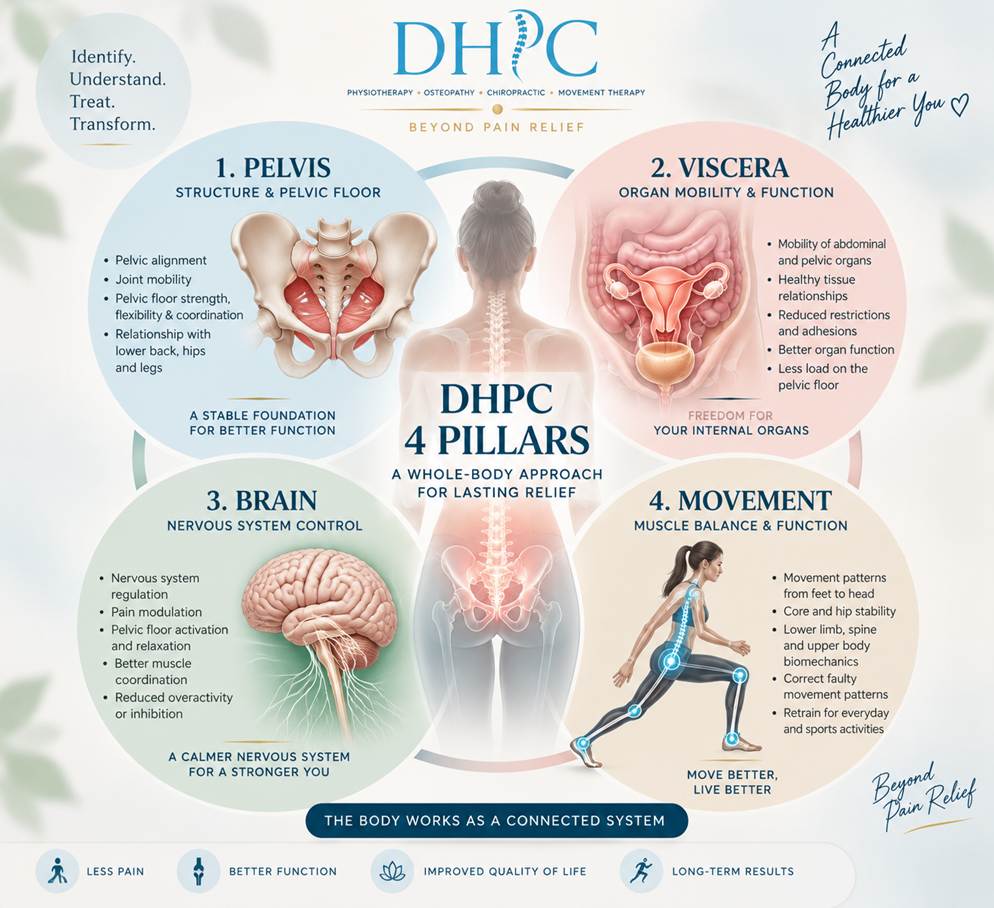
At Dr. Harsha’s Physiotherapy Clinic (DHPC), pelvic pain is assessed as part of an interconnected system. Our framework considers four broad pillars: Pelvis, Viscera, Brain/Nervous System and Movement. The aim is to understand the individual presentation and then select treatment according to the assessment.
Pillar 1: Pelvis, Alignment & Pelvic Floor
The pelvis is a key structural region connecting the spine and lower limbs. Its position, mobility and muscular control influence the way the surrounding tissues function.
The pelvic floor is not simply a muscle group that everyone with pelvic symptoms needs to strengthen. Depending on the person, it may be weak, tight, overactive, poorly coordinated or unable to relax effectively.
- Pelvic alignment and mobility
- Hip and lower-back function
- Pelvic-floor strength and coordination
- Pelvic-floor overactivity or difficulty relaxing
- Relationship between the pelvis, hips and lower back
The pelvic cavity contains important organs including the uterus, ovaries, bladder, prostate and intestines. Changes in the surrounding musculoskeletal and connective-tissue environment can influence how these structures interact. This is one reason a detailed assessment is preferable to assuming that every pelvic symptom has the same cause.
Pillar 2: Viscera – Mobility & Function of Internal Organs
Internal organs have physiological movement and mobility within the surrounding tissues. Inflammation, surgery, scar tissue or adhesions can affect the normal mobility of tissues around the abdominal and pelvic organs.
For example, endometriosis can be associated with inflammation and adhesions and may contribute to pelvic pain and restricted tissue mobility. Adenomyosis is different: endometrial-type tissue grows into the muscular wall of the uterus and can be associated with an enlarged or heavier uterus.
At DHPC, visceral osteopathy may be incorporated when appropriate to the individual assessment. The clinical aim is to work with the mobility and mechanical relationships of abdominal and pelvic tissues rather than simply treating the painful area.
▶ Watch: DHPC Visceral Osteopathy Video
Pillar 3: Brain & Nervous System
The pelvic floor is controlled by the nervous system. In some people, nervous-system factors may contribute to excessive muscle activity, difficulty relaxing, altered coordination or persistent pain sensitivity.
This means that pelvic symptoms are not always simply a problem of weak muscles. A person may have a pelvic floor that is overactive and tight, while another may have poor activation or coordination.
When the assessment indicates a nervous-system component, cranial osteopathy may be incorporated into the overall treatment strategy.
▶ Watch: DHPC Cranial Osteopathy Video
Pillar 4: Movement – The Body Does Not Move in Isolation
The pelvic floor works together with the feet, knees, hips, pelvis, lower back, core and breathing system. A faulty movement pattern in one region can change how the body loads and controls another region.
- Foot and ankle mechanics
- Hip mobility and stability
- Pelvic and lower-back movement
- Core control and pressure management
- Upper-body mechanics when relevant
- Functional movement and movement retraining
The goal is to identify movement patterns that may be contributing to symptoms and retrain them rather than repeatedly treating only the painful area.
DHPC 3-Phase Approach to Pelvic Pain Treatment
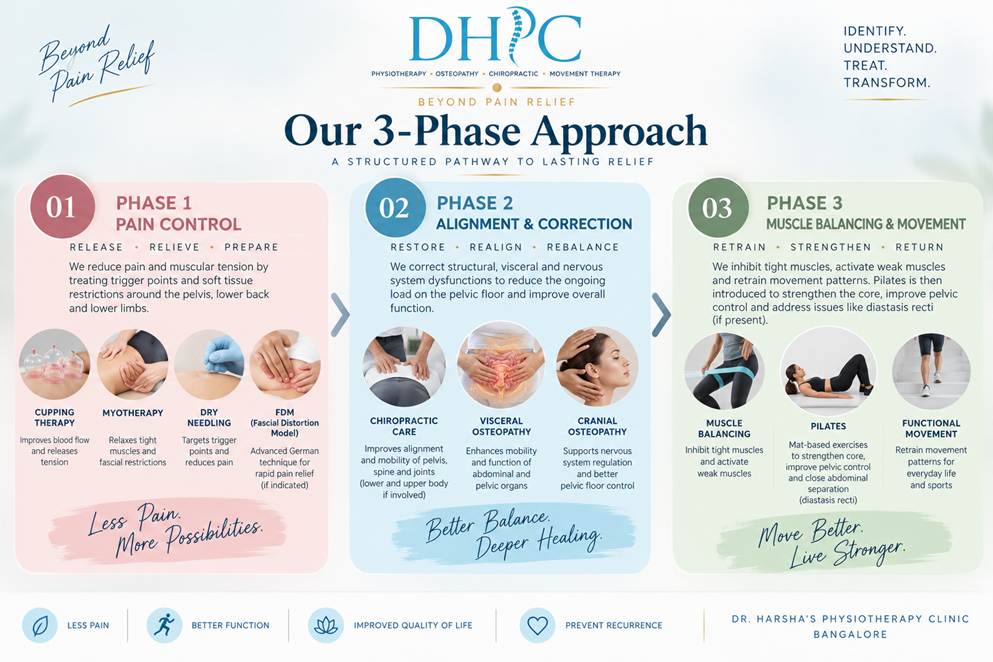
Treatment is individualized. Not every patient needs every technique shown below. The sequence and combination depend on the findings of the assessment, symptoms, medical history and response to treatment.
Phase 1: Pain Control & Myofascial Release
The first phase focuses on reducing pain, trigger points, excessive muscle tension and relevant soft-tissue restrictions around the pelvis, hips, lower back and legs.
- Cupping therapy
- Myotherapy and soft-tissue techniques
- Dry needling for selected trigger points
- FDM (Fascial Distortion Model) when clinically indicated
FDM is an advanced manual therapy approach developed in Germany and may be used where the clinical presentation indicates it is appropriate.
Phase 2: Alignment, Visceral & Nervous-System Correction
Once pain and excessive muscular restriction are addressed, treatment can progress toward the structural, visceral and nervous-system factors identified during assessment.
- Chiropractic care for relevant pelvic, lower-back and lower-limb alignment and mobility
- Upper-body correction when it contributes to the movement problem
- Visceral osteopathy to address relevant abdominal and pelvic tissue mobility
- Cranial osteopathy when nervous-system factors are identified as relevant
Phase 3: Muscle Balancing, Core Rehabilitation & Pilates
The final phase focuses on rebuilding appropriate movement and muscle control. Tight or overactive muscles may need to be inhibited or relaxed, while weak or poorly activated muscles may need progressive strengthening.
If core weakness or diastasis recti (abdominal separation) is contributing to the presentation, Pilates-based rehabilitation may be introduced. Mat-based Pilates exercises can progressively strengthen the core, improve pelvic control and retrain coordinated movement.
Why a Detailed Physiotherapy Assessment Matters
Pelvic pain is not a one-size-fits-all problem. Two people may have the same symptom but very different contributing factors. One person may have pelvic-floor overactivity, another may have weakness and poor coordination, while another may have a combination of musculoskeletal, visceral, nervous-system and movement factors.
- Posture and alignment
- Pelvic and lower-back mobility
- Hip and lower-limb function
- Core function and breathing
- Pelvic-floor function where appropriate
- Muscle tightness, weakness and coordination
- Relevant visceral mobility
- Nervous-system and movement factors
| DHPC Philosophy Identify the contributing factors → reduce pain → restore mobility and alignment → retrain movement → build capacity and function. |
Frequently Asked Questions
Can physiotherapy help pelvic pain?
Physiotherapy can help manage pelvic pain and associated pelvic-floor, musculoskeletal and movement dysfunction. The appropriate treatment depends on the underlying presentation.
Can weak pelvic-floor muscles cause pelvic pain?
Weakness can contribute to pelvic dysfunction, but pain is not always caused by weakness. Some people have an overactive or tight pelvic floor and need relaxation or coordination work rather than more strengthening.
Can a tight pelvic floor cause pelvic pain?
Yes. Pelvic-floor overactivity and difficulty relaxing can contribute to pelvic pain and other pelvic symptoms.
Is pelvic pain always caused by the pelvic floor?
No. Pelvic pain can involve muscles, joints, nerves, internal organs, movement patterns and medical conditions. A broader assessment can help identify the relevant contributors.
Can endometriosis cause pelvic pain?
Yes. Endometriosis is associated with pelvic pain in many people and can also be associated with inflammation and adhesions. Physiotherapy can address associated musculoskeletal and pelvic-floor dysfunction but does not remove endometriosis lesions.
Can an enlarged or heavier uterus contribute to pelvic symptoms?
Conditions such as adenomyosis or uterine fibroids can be associated with an enlarged uterus. This may contribute to pelvic pressure or other symptoms in some people and should be medically evaluated.
Do I need to strengthen my pelvic floor if I have pelvic pain?
Not necessarily. The pelvic floor may be weak, tight, overactive or poorly coordinated. Assessment should guide whether the priority is strengthening, relaxation, mobility or coordination.
Can Pilates help pelvic pain?
Pilates can be useful when core weakness, muscle imbalance, movement dysfunction or abdominal separation is contributing to the problem. Exercise should be individualized.
How many sessions will I need?
There is no fixed number. Recovery depends on the cause, duration and severity of symptoms, associated conditions and response to treatment.
Is pelvic physiotherapy safe?
Pelvic physiotherapy is generally safe when performed by an appropriately trained physiotherapist. Any assessment or treatment should be explained beforehand and performed with the patient’s consent and comfort.
When Should You Seek Medical Evaluation?
Pelvic pain can sometimes be associated with medical conditions that require diagnosis and treatment by a gynaecologist, urologist, gastroenterologist or another medical professional. Seek medical evaluation for new, severe, unexplained, persistent or worsening pain, abnormal bleeding, fever, significant urinary or bowel symptoms, pregnancy-related concerns, or other symptoms that worry you.
Pelvic Pain Treatment at Dr. Harsha’s Physiotherapy Clinic
At DHPC, we believe pelvic pain deserves more than a generic exercise plan. Our approach combines physiotherapy, pelvic-floor rehabilitation, osteopathy, chiropractic care, movement rehabilitation and Pilates according to the individual’s assessment.
| Beyond Pain Relief If pelvic pain, pelvic heaviness, urinary symptoms, core weakness or pelvic-floor dysfunction is affecting your daily life, a detailed assessment can help identify the factors contributing to your symptoms. |