Neck Pain: Your Neck May Not Be the Real Problem — A Root-Cause Physiotherapy Approach
Neck pain is one of the most common musculoskeletal problems today. It can cause stiffness, difficulty turning your head, shoulder discomfort, headaches, muscle tightness and sometimes pain extending towards the arm.
For many people, the first thought is: “Is there something wrong with my cervical spine? Do I need an X-ray or MRI?”
At Dr. Harsha’s Physiotherapy Clinic (DHPC), we take a different starting point.
Before looking for a picture of the problem, we look at how your body is moving.
Because the place where you feel pain is not always the place where the problem starts.
A person may feel pain in the neck while the underlying movement problem may involve the shoulder blade, shoulder joint, posture, muscle coordination—or, in selected cases, other structures that can influence the body’s mechanics.
This is why a detailed physiotherapy assessment for neck pain is an important first step.

Do You Always Need an X-Ray or MRI for Neck Pain?
Not necessarily.
For uncomplicated neck pain without concerning symptoms, imaging is not always required at the beginning of treatment. An X-ray or MRI may show age-related changes, disc bulges, degeneration or other findings that are common even in people who do not have pain.
This can sometimes make patients unnecessarily worried.
At DHPC, we believe that a scan should be interpreted in the context of the patient’s symptoms and physical examination—not treated as the diagnosis by itself.
A scan shows anatomy. A physical assessment helps us understand how that anatomy is functioning during movement.
There are also situations where imaging or medical evaluation is important—for example, after significant trauma, when neurological symptoms are progressive, or when other red flags are present. In those situations, appropriate medical referral takes priority.
The goal is not to avoid scans. The goal is to use them when they are clinically appropriate.
Why Does Your Neck Hurt When the Real Problem May Be Elsewhere?
Think of your body as a chain.
Your neck, shoulder blade, collarbone and shoulder joint do not work independently. They have to coordinate with each other every time you lift your arm, reach overhead, work on a laptop, use your phone, carry a bag, drive, exercise or sleep in certain positions.
If one part of this system is not moving efficiently, another part may have to compensate.
Over time, the muscles doing extra work can become overloaded and painful.
This is one reason why treating only the painful neck muscle may provide temporary relief without addressing the underlying movement problem.
Step 1: Detailed Static Assessment
At DHPC, the assessment begins with looking at alignment and positioning.
We assess structures including the scapula or shoulder blade, clavicle or collarbone, humerus or upper-arm bone, shoulder joint position, cervical spine posture, and head and neck position.
For example, one shoulder blade may sit lower than the other, the collarbones may have different orientations, or the upper arm may sit in a forward-rotated or anteriorly translated position.
Long periods of sitting, laptop use and smartphone use can contribute to a forward-head and slouched posture. When the shoulder complex does not sit or move efficiently, the muscles around the neck and shoulder may have to work harder to maintain stability and movement.
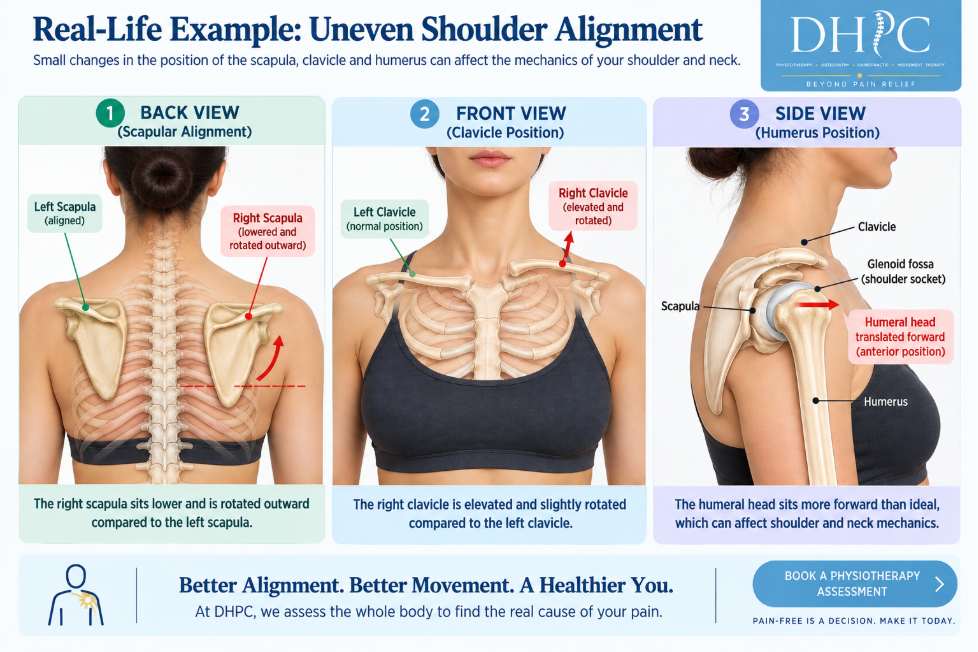
Graphic 1. Uneven shoulder alignment: scapular asymmetry, clavicular elevation/rotation and anterior humeral positioning can alter shoulder and neck mechanics.
Step 2: Dynamic Movement Assessment — Finding the Muscle That Is Not Doing Its Job
Static posture tells us how the body is positioned.
But the more important question is: How does your body move?
At DHPC, movement assessment includes Kinetic Control-based movement analysis, using principles from Comera Movement Science, London.
This helps us observe whether particular muscles or muscle groups are overactive or over-recruiting, underactive or inhibited, poorly coordinated, or unable to provide adequate stability.
An Example: When Shoulder Movement Creates Neck Pain
Imagine lifting your arm sideways and overhead.
The shoulder blade needs to move in coordination with the arm. It should rotate appropriately as the arm elevates.
If the shoulder blade does not move efficiently, the muscles responsible for movement and stabilisation may have to compensate.
One possible pattern is reduced efficiency of the serratus anterior, causing other muscles such as the upper trapezius and deltoid to work harder.
Think of it like this: One employee stops doing their job → another employee has to do two jobs.
Initially, the body can compensate.
But if that compensation continues for weeks or months, the overworking muscles may become fatigued, tight and painful.
The patient may then develop neck pain—even though the contributing movement problem may be at the shoulder.
This is why DHPC does not simply ask, “Where does it hurt?” We also ask, “Why is this area having to work so hard?”
The DHPC 3-Phase Approach to Neck Pain Treatment
Once the assessment identifies the contributing factors, treatment is planned according to the patient’s presentation. At DHPC, our treatment approach can be broadly explained in three phases.
PHASE 1: Trigger Point Release & Pain Control
Goal: Reduce pain and calm overloaded tissues.
When a patient is experiencing significant pain, the first priority is often to reduce pain and muscle overactivity sufficiently to allow better movement.
Depending on the individual assessment, treatment may include cupping therapy, dry needling, Fascial Distortion Model (FDM), kinesiology taping, therapeutic ultrasound, IFT, manual therapy and other physiotherapy techniques where appropriate.
These techniques are selected based on the patient’s clinical presentation rather than used as a fixed protocol for everyone.
The objective is not simply to make the patient feel better temporarily. It is to create a better starting point for restoring movement.
PHASE 2: Alignment Correction & Internal Mechanical Factors
Goal: Improve alignment and address contributing mechanical factors.
Once pain is more manageable, treatment can progress towards correcting movement and alignment problems identified during assessment.
Depending on the patient’s presentation, DHPC may use chiropractic correction, osteopathic techniques, visceral osteopathy when clinically indicated, manual therapy and mobility work.
The aim is to improve the way different parts of the body interact with each other.
Can Internal Structures Contribute to Neck Pain?
In some patients, musculoskeletal factors may not explain the entire presentation.
At DHPC, we also consider possible visceral contributions when the assessment suggests they may be relevant.
For example, the position and mobility of internal organs can influence surrounding tissues and fascial relationships. In selected cases, restrictions or altered tissue tension involving the abdominal or thoracic region may contribute to altered posture or tension patterns reaching the neck.
If the clinical assessment suggests a visceral component, osteopathic assessment may therefore be incorporated into the treatment plan.
This does not mean that every neck-pain patient has a visceral problem. It means that treatment should be based on the individual assessment rather than assuming every neck problem originates in the cervical spine.
PHASE 3: Muscle Balancing & Movement Retraining
Goal: Correct the movement strategy that contributed to the problem.
Pain relief is only one part of recovery. If the same movement dysfunction remains, the problem may return.
This is where Kinetic Control-based exercises become important.
The objective is to identify muscles that are over-firing, under-recruiting or poorly coordinated and then work on improving muscle activation and movement control.
In simple words: Relax the muscles doing too much. Activate the muscles doing too little. Teach the body to move efficiently again.
This is not simply about making muscles stronger. It is about teaching the right muscles to work at the right time and in the right amount.
Why Treating Only the Neck May Not Be Enough
Imagine a warning light appearing on your car dashboard. Replacing the warning light does not necessarily fix the mechanical problem.
Similarly, reducing neck pain does not always mean the contributing movement problem has been corrected.
A patient may feel better after massage, dry needling, cupping, manual therapy or pain medication. But if an underlying movement dysfunction remains, symptoms may recur.
This is why DHPC focuses on: Assessment → Root Cause → Pain Control → Correction → Movement Retraining.
What Can Cause Neck Pain?
Poor posture: Long periods of sitting, laptop use and smartphone use can contribute to increased mechanical stress and muscle workload.
Muscle overload: When certain muscles repeatedly perform more work than they are designed to handle, they may become painful or fatigued.
Shoulder and scapular dysfunction: Poor shoulder-blade control can alter the mechanics of the neck and upper limb.
Cervical joint dysfunction: Reduced mobility or altered movement of the joints of the cervical spine can contribute to pain and stiffness.
Disc-related conditions: Disc bulges, herniations and degenerative changes can sometimes be associated with symptoms, but imaging findings should be interpreted alongside the clinical presentation.
Nerve irritation: Neck problems can sometimes cause pain, tingling, numbness or weakness extending into the arm or hand.
Previous injury: Whiplash, falls, sports injuries and other trauma can affect the muscles, joints and other tissues around the neck.
Movement-control problems: A muscle may be capable of producing force but may not be coordinating movement effectively. This can create compensatory patterns.
Common Symptoms of Neck Pain
- Localised neck pain
- Neck stiffness
- Difficulty turning the head
- Pain around the shoulder
- Upper-back discomfort
- Pain at the base of the skull
- Headaches associated with neck dysfunction
- Muscle tightness or trigger points
- Pain with prolonged sitting
- Pain after prolonged smartphone use
- Tingling or numbness in the arm or hand
- Reduced neck movement
The symptoms alone, however, do not always reveal the underlying cause. That is why assessment matters.
When Should You See a Doctor or Get Imaging?
Seek prompt medical attention if neck pain is associated with significant trauma or a serious accident, progressive weakness, severe or worsening neurological symptoms, loss of bladder or bowel control, severe unexplained symptoms, fever with concerning neck symptoms, unexplained weight loss, or other symptoms suggesting a serious underlying condition.
Physiotherapy assessment is appropriate for many musculoskeletal presentations, but your physiotherapist can also determine when medical referral or imaging may be appropriate.
The objective is not “no MRI.” The objective is “the right investigation for the right patient at the right time.”
What Happens During a Neck Pain Physiotherapy Assessment at DHPC?
- Understanding your history: When the pain started, what aggravates it, what relieves it and how it affects daily activities.
- Postural and alignment assessment: The position and relationship of the head, neck, shoulder blade, clavicle and shoulder.
- Mobility assessment: How the neck, shoulder and related regions move.
- Muscle assessment: Signs of muscle overactivity, weakness or poor coordination.
- Dynamic movement analysis: How the body behaves during functional movements.
- Root-cause analysis: Connecting findings rather than treating every symptom as an isolated problem.
- Individualised treatment plan: Selecting the appropriate treatment strategy based on the assessment.
Why DHPC Takes a Root-Cause Approach to Neck Pain
At Dr. Harsha’s Physiotherapy Clinic (DHPC), we believe:
Don’t just ask where the pain is. Find out why the body is creating the pain.
Our approach combines physiotherapy with appropriate manual therapy, movement assessment, osteopathic and chiropractic approaches, and movement retraining when clinically indicated.
The DHPC philosophy can be summarised as: Assess → Understand → Treat → Retrain → Prevent.
The aim is not simply to provide temporary pain relief. The aim is to help you understand the factors contributing to your pain and restore more efficient movement.
Frequently Asked Questions About Neck Pain Physiotherapy
Do I need an MRI for neck pain?
Not necessarily. Many uncomplicated neck-pain cases can initially be assessed clinically without immediate imaging. If your symptoms or examination indicate that imaging is appropriate, your physiotherapist or doctor can recommend further evaluation.
Can neck pain come from the shoulder?
Yes. The neck and shoulder work together as a movement system. Altered scapular movement, shoulder mechanics or muscle coordination can increase the workload on the neck.
Can poor posture cause neck pain?
Poor posture can contribute to increased mechanical stress and muscle workload, particularly when maintained for prolonged periods. However, posture is only one potential contributor.
Can a disc bulge cause neck pain?
It can be associated with symptoms in some people, but a disc bulge on an MRI does not automatically mean it is the cause of pain. Imaging findings need to be interpreted together with symptoms and physical examination.
Why does my neck pain keep coming back after massage?
Massage may reduce muscle tension and symptoms, but if an underlying movement or load-management problem remains, symptoms may recur. Rehabilitation and movement retraining may therefore be important.
Can physiotherapy help neck pain without surgery?
Many musculoskeletal neck-pain conditions can be managed conservatively with physiotherapy, exercise and appropriate rehabilitation. The treatment approach depends on the individual’s diagnosis and clinical findings.
What is Kinetic Control?
Kinetic Control is a movement-control approach that examines how a person controls movement and identifies inefficient movement strategies, including muscles or muscle groups that may be overactive or insufficiently contributing.
Can shoulder-blade problems cause neck pain?
They can contribute to neck symptoms in some patients because the shoulder blade, shoulder and neck function as an interconnected movement system.
How long does neck pain physiotherapy take?
Recovery varies according to the cause, severity, duration of symptoms, contributing factors and individual response to treatment. Your physiotherapist can provide a more meaningful estimate after assessment.
Should I start neck exercises on my own?
Not every neck exercise is appropriate for every patient. It is better to identify the underlying movement problem first and then select exercises according to the assessment.
Don’t Just Treat the Pain. Find the Reason Behind It.
If your neck has been hurting repeatedly despite massage, medication, temporary treatments or repeated rest, it may be time to look beyond the painful area.
A detailed physiotherapy assessment can help identify whether your symptoms are being influenced by neck movement, shoulder alignment, scapular control, muscle coordination, posture, movement habits or other contributing factors.
At DHPC, our goal is to identify the contributing factors, reduce pain, restore movement and help you return to your normal activities with greater confidence.
Don’t just ask, “Where does it hurt?”
Ask, “Why does it hurt?”
Dr. Harsha’s Physiotherapy Clinic (DHPC)
Physiotherapy • Osteopathy • Chiropractic • Movement Therapy
Pain-free is not a dream; it’s a decision—Make it today.